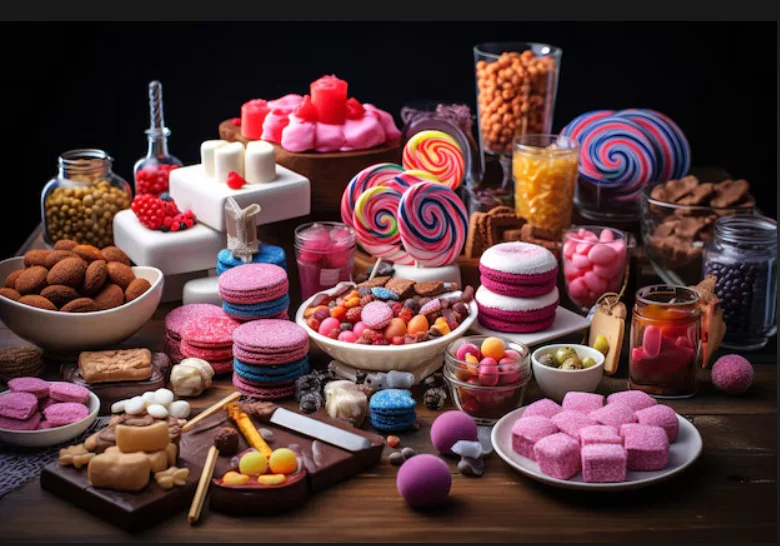
Sweet and Confectionery

Sweets and confectionery refer to a wide range of food products that are primarily rich in sugar and designed to provide sweetness, flavour, and enjoyment. These products are widely consumed across all age groups and are an important part of cultural traditions, celebrations, and the food industry.
1. Definition
• Sweets: Traditional or modern food items prepared using sugar, milk, ghee, flour, nuts, and flavouring agents (e.g., Indian mithai like laddoo, barfi, etc.).
• Confectionery: Commercially processed sweet products, mainly categorised into sugar-based candy and chocolate-based items.
1. Key Ingredients
• Sugar (sucrose, glucose syrup)
• Milk and milk solids
• Cocoa and chocolate
• Fats (butter, ghee, vegetable oils)
• Flavouring agents and colours
• Nuts, dry fruits, emulsifiers, stabilisers
2. Processing Techniques
• Heating and boiling (sugar syrup formation)
• Crystallisation control
• Mixing, moulding, and shaping
• Cooling and packaging
• Chocolate tempering (for glossy finish and texture)
3. Key Laboratory Test Parameters
A. Physico-Chemical Parameters
Moisture content, Total ash, Acid insoluble ash, pH, Total soluble solids (°Brix), Reducing sugars, Total sugars, Sucrose content, Fat content, Protein content, Peroxide value (for fat oxidation), Free fatty acid (FFA), Energy value (kcal)
B. Milk-Based Sweet Parameters (e.g., peda, barfi, khoa sweets) Milk fat(%), Milk protein(%), Lactose content, Added starch, detection Urea (adulteration check), Neutralisers (e.g., sodium carbonate)
C. Chocolate & Cocoa Products
Cocoa solids(%), Cocoa butter(%), Total fat(%), Theobromine content, Sugar profile, Emulsifier (lecithin) level.
D. Food Additives & Adulteration
Synthetic colours (qualitative & quantitative), Preservatives (Benzoic acid, Sorbic acid), Artificial sweeteners (Saccharin, Aspartame), Starch adulteration, Detergent/soap (in milk sweets)
E. Heavy Metals
F. Microbiological Parameters
G. Mycotoxins (if applicable)
• Ensures food safety and consumer health
• Detects adulteration and contamination
• Maintains product consistency and quality
• Required for regulatory compliance and export certification
4. Conclusion
Testing of sweets and confectionery products is essential due to their high sugar and fat content, which makes them prone to microbial spoilage and adulteration. Laboratories must follow validated methods such as FSSAI, AOAC, BIS, and ISO standards for accurate and reliable results.